


 (65) 6908 8969
 (65) 6908 8969
Tinnitus of The Ear: How to Get Better
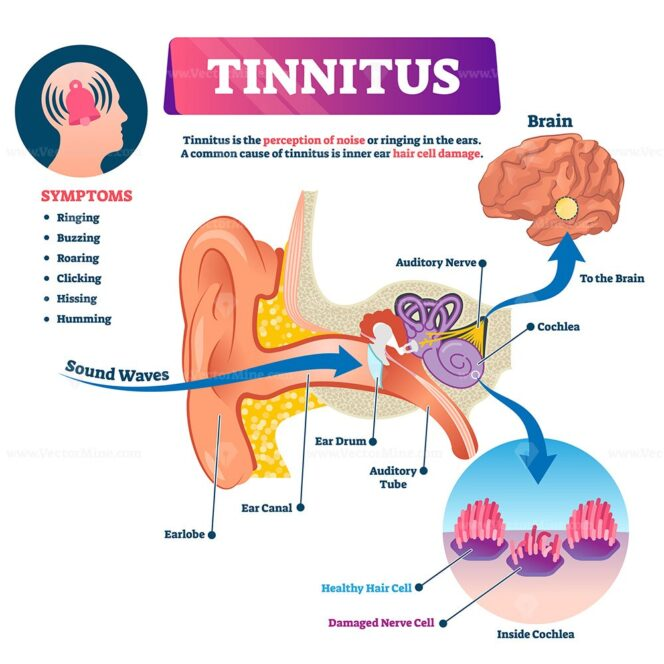
WHAT DOES HAVING TINNITUS MEAN?
Ever wondered what that annoying buzzing or ringing noise was in your ear? The name for this sort of inner ear noise is tinnitus, from the Latin term “tinnire” (to ring or tinkle). As an experienced ENT specialist in Singapore, we manage many such patients. We also help them to understand their complex condition so that they feel better. Many people mistakenly assume that “there is nothing you can do” about tinnitus which is not quite true. Depending on the cause and severity, we are able to help patients deal with their tinnitus better. Do you know someone who suffers from this?
WHAT ARE THE DIFFERENT TYPES?
Some rare types of tinnitus may be objective. This means that these can be heard by other people too. Tinnitus which is pulsatile in nature (“like a heartbeat”) is also a bit more worrying. These types definitely need further investigation with a CT or MRI scan. We need to find out if the tinnitus might be originating from abnormalities of the blood vessels in the head and neck. Sometimes, the scan will detect problems such as an aneurysm, a weak dilated part of a blood vessel.
Most patients whom we see at ENTcare specialist clinic in Singapore, tend to have the subjective type. This means that only the sufferer can hear the noise in their ear. One of the most common causes of funny noise in the ear is due to underlying hearing loss. Many patients may not realise that he or she has some early inner ear degeneration. As we grow older, we tend to lose our high frequency hearing. This often leads to tinnitus, as the inner ear hearing organ, the cochlea, undergoes age-related changes. Wearing a hearing aid can help alleviate the annoying ear noise and help with the hearing loss at the same time.
COULD MY TINNITUS BE CAUSED BY NOISE DAMAGE?
Another common cause is inner ear damage due to previous noise exposure. Some patients may suffer more than one kind of tinnitus at the same time in one or both ears. Tinnitus can present as a whistling, rustling, crackling, popping, whining, humming, dripping, whooshing noise in the ear. Here’s the interesting thing: If the room is quiet enough, technically everyone will notice some sort of noise in their ear!
DOES IT TEND TO BOTHER EVERYONE?
Another interesting observation: Tinnitus does not seem to bother everyone even though they have it! Some patients become so severely disturbed that they find it difficult to conduct their usual activities. Even worse, it may prevent them from sleeping or wake them up. The common triggers include stress, fatigue and anxiety. Hence, it is important to manage the psychosocial aspects of this condition properly with specialised counselling. Sometimes, we prescribe special medications to help our patients sleep better and relax. In extremely severe cases who also have poor hearing, then a cochlear implant may be an option.
DO I NEED TO WORRY IF TINNITUS ONLY AFFECTS ONE EAR?
Persistent tinnitus in one ear in Singapore is investigated with an MRI scan to rule out the rare cause of a benign inner ear nerve tumour, called an acoustic neuroma. Tinnitus may be the very first symptom of an acoustic neuroma but its loudness has no correlation with the size of any underlying inner ear tumour. The postnasal space (area behind the nose) should also be examined with a nasal endoscope as nose cancer may sometimes present like this.
We manage our tinnitus patients in Singapore with care as this is a highly complex condition. So identifying the cause and listening to the finer details is important in helping you get better. Seeing an ENT specialist who has specialised experience in hearing and balance conditions is the key to getting you better.
Dr Annabelle’s Tips:
- Avoid being in a room that is too quiet. Some background noise is usually helpful in masking the noise in your ear e.g. whirring fan, humming air-conditioner, soft music playing in the background.
- Make sure you get a hearing test done at a reliable centre. High frequency hearing loss often goes hand-in-hand with tinnitus. However mild to moderate hearing loss may not be noticed yet by the patient.
- See an experienced ENT specialist earlier rather than wait many years before doing so. It is always easier to manage the tinnitus at the early stage first. In later stages, it becomes associated with anxiety or depression.
Share this blog via: