

 (65) 6908 8969
 (65) 6908 8969
Blocked Nose and Snoring: How To Breathe Well
Are you suffering from a persistently blocked nose and snoring, causing difficulty breathing? Many people have a frequently or persistently blocked nose and snoring. The don’t even realise that they are depending on their mouths to breathe. Do you know that mouth-breathing is abnormal? You only use your mouth to breathe if your nose feels blocked!
Mouth-breathing usually means that your nasal airways are blocked. This restricts oxygen flow into your body, affecting your sleep and daytime work performance. Some people with a blocked nose all their lives don’t even know what it’s like to breathe clearly!
WHY SHOULDN’T I KEEP USING THE OFF-THE-COUNTER NASAL SPRAYS?
As an ENT specialist in Singapore for children and adults, I see many patients with blocked nose and snoring. Some patients have been using over-the-counter medications. Examples include Afrin, Iliadin and Oxymetazoline decongestant sprays. They keep using them daily to help them breathe. Although nasal decongestant sprays help nasal congestion, you should avoid longterm use. It is difficult to stop using decongestant sprays if used for too long.
There is also a risk of rebound congestion with longterm use. So this means that there is a higher risk of sinus infections with worse symptoms than before. Rhinitis medicamentosa is the medical term for prolonged use of nasal decongestant sprays. It is very challenging to treat.
The nerve endings in the soft tissue inside the nose become desensitised with longterm use of nasal sprays. They react abnormally to airflow, temperate and humidity changes. It becomes a vicious cycle because some patients spray their nose even more often, which just makes it worse.
WHY DO I KEEP SUFFERING A BLOCKED NOSE AND SNORING?
So if you find that you just can’t seem to live without your nasal decongestant spray, something’s wrong! You should see your friendly ENT specialist in Singapore for a thorough nose check-up. There are many causes of persistent nose congestion. The list includes deviated nasal septum, swollen inferior turbinates, enlarged adenoids, nasal polyps and rarely, a nasal tumour.
Nasal allergies cause excessive mucus and nasal congestion. Furthermore, allergic rhinitis may result in an irritating nasal backdrip and persistent cough! The key point is that lower airway symptoms such as a cough, often originate from upper airway conditions. Therefore if left untreated, these will lead to a persistent postnasal drip. The backdrip then flows down into your throat and causes a persistent cough, keeping you up at night.
WHY DO I KEEP GETTING A POSTNASAL DRIP?
Many patients see the respiratory specialist first, assuming that it is a lung condition. So they start medications like inhalers for asthma. But hold on! Perhaps you don’t actually have asthma! Your hypersensitive lower airways of the lungs may be reacting to the postnasal backdrip itself.
Imagine a tap left running 24 hours a day, 7 days a week! The “tap” pours wet sticky mucus down the back of your nose to enter the windpipe and lungs! The cough reflex is trying to clear the mucus from your lower airways. So why don’t you treat by turning off the dripping tap above?
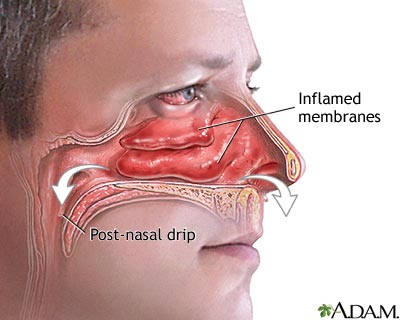
Your friendly ENT specialist in Singapore will examine your nose with “The scope”. This is a tiny camera to view your upper airway from the nostrils to the back of the nose. It can also look at the throat and voicebox. The most common causes of a persistently blocked nose are 1) deviated nasal septum and 2) enlarged swollen inferior turbinates, the “sausages” of the nose. Structural reasons and soft tissue problems need to be corrected to improve the nasal airways to help you breathe.
HOW CAN I TREAT MY BLOCKED NOSE AND SNORING?
Use the same group of medications to improve the blocked nose and postnasal drip symptoms! These consist of sea salt saline irrigation, nasal steroid sprays and antihistamines. After a viral upper respiratory tract infection like the flu or Covid infection, the nose will produce too much mucus as a backdrip. This can last for a few weeks. Antibiotics may not always help!
WHAT ABOUT SURGERY TO HELP ME BREATHE BETTER THROUGH MY NOSE!
What happens if you still can’t breathe through your nose despite using nasal sprays and tablets? Surgery can correct the deviated nasal septum and enlarged soft tissue of the inferior turbinates. These procedures are called “septoplasty” and “turbinoplasties“. They help to open up the blocked nasal passages to help you breathe clearly. We often perform these 2 nasal procedures together at the same time under a short general anaesthesia.
They don’t usually cause much discomfort. We may insert packing into your nose to prevent bleeding but one side of the nose for comfort. The nasal packs are gently slid out of the nose the following morning after surgery if there is an overnight stay postop.
TELL ME ALL ABOUT THE SURGERY: SEPTOPLASTY AND TURBINOPLASTIES
Septoplasty with turbinoplasties work well to help patients breathe and hence sleep better, helping you function better in the daytime at work and at school. The weird thing is, some people have been living their entire lives with a blocked nose. In fact, they don’t realise that having a blocked nose and breathing mostly through their mouth, is abnormal. So surgery plays a life-changing role in improving their breathing. Therefore they are absolutely amazed!
In conclusion, having a blocked nose and coughing with an itchy throat or backdrip is abnormal. But it is definitely treatable! See your friendly ENT specialist in Singapore for help with your breathing issues.
Share this blog via: