


 (65) 6908 8969
 (65) 6908 8969
My Child’s Blocked Nose and Cough Isn’t Better: Why?

Ear, Nose and Throat (ENT) problems in children are pretty common in Singapore, as well as all over the world! So what common ENT conditions trouble our little ones? At ENTcare specialist clinic in Singapore, many kids present to us with blocked nose, persistent coughing and difficulty breathing. This can occur both during the daytime and at night when asleep.
Noisy breathing, including snoring, isn’t normal! It usually suggests some sort of airway obstruction either at the nasal or throat levels. Having a constantly stuffy blocked nose, sometimes with slimy mucus, isn’t normal for your poor child either.
Some children have so much difficulty trying to eat and breathe at the same time that they just can’t! Then they either end up being a poor eater or make some strange mucus noises in their nose and throat. This is because they can’t swallow their food and breathe through their blocked nose at the same time.
If you tried to swallow your food with a blocked nose, you wouldn’t be able to do so either! If your nasal airways are blocked, your mouth is the only passageway for air to enter your lungs. This may then lead to recurrent choking or coughing spells in your poor child at mealtimes.
IS A PERSISTENT COUGH WORRYING?
Suffering a persistent cough is abnormal too. Most cough symptoms related to the common cold or the flu, usually settle down within a few days. But if your child keeps coughing, sometimes until they vomit, this is rather worrying. Your child needs to be checked out by your friendly ENT specialist in Singapore.
The repeated bouts of coughing may prevent your poor child from sleeping properly. So if your child doesn’t get enough rest to recover, this disturbs their parents who also become sleep-deprived! We all know how important sleep is in allowing the immune system to stay strong and healthy.
The three symptoms of loud snoring, blocked nose with persistent cough often occur together. But what are the common causes? Is there anything to worry about? When should you bring your child to see your friendly ENT specialist? Let’s see what causes persistent loud snoring, nasal congestion and cough in children:
1.Upper respiratory tract infection (usually viral such as the common cold or the flu)
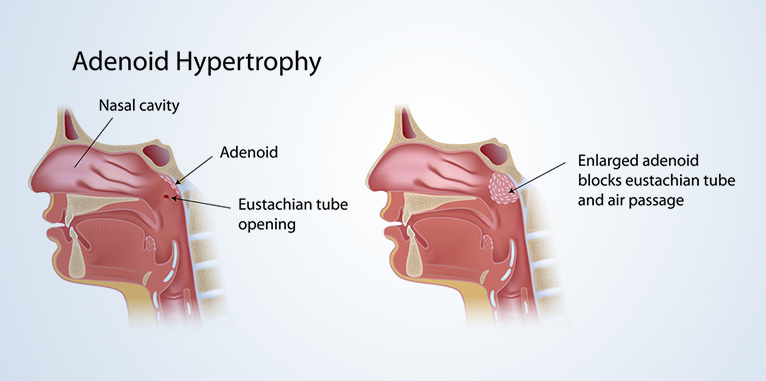
Viral infections of the nose and throat lead to swelling of the soft tissue inside the nose. The “sausages” of the nose, called the turbinates, enlarge. The adenoids may grow in size in response to the ongoing inflammation because they consist of reactive lymph gland tissue. So if your child suffers from a bad cold or nasal allergies, there is a good chance that those adenoids are going to swell up and block your child’s nose too.
Imagine having a very juicy big head of broccoli growing at the back of your nose. You can’t see this head of broccoli but it’s large enough to obstruct the airway. The enlarged adenoids cause noisy breathing, loud snoring, difficulty breathing and restless disturbed sleep patterns at night!
WHAT ARE THE TONSILS AND ADENOIDS FOR?
The adenoids and tonsils form a protective ring of lymph gland tissue in the nose and throat. They are part of your immune system to fight infections in the young child. But did you know that over time, they naturally shrink from the ages of 5-8 years? Most adults have minimal adenoid and tonsil tissue remaining because the importance of the adenoids and tonsils slowly reduces with age. Other parts of the immune system take over, such as the spleen, bone marrow and the maturing blood circulation.
The problem is, natural shrinkage of the adenoids and tonsils does NOT happen in every child. We still see some adults with the same sort of obstructive symptoms due to persistently enlarged tonsils and adenoids since childhood. Why? Their parents had either chosen a conservative approach or were completely unaware.
WON’T MY CHILD’S IMMUNITY BE AFFECTED IF THE TONSILS ARE REMOVED?
What is the commonest question I get asked by many concerned parents? Their child is clearly suffering from airway obstruction and disturbed sleep/obstructive sleep apnea issues.
But parents always ask: “Won’t my child’s immunity be much worse after the adenoids and tonsils are removed?”
Now let me make it very clear: NOT EVERY child needs to have their tonsils and adenoids removed!
We only consider adenotonsillectomy IF there is strong evidence of :
- Recurrent throat infections
- Persistent cough due to the thick infected backdrip from the enlarged swollen inflamed adenoids
- Persistent loud snoring
- Recurrent gasping and choking with funny noises in nose and throat
- Disturbed restless sleep patterns and positions
- Nocturnal waking episodes
- Daytime fatigue
- Behavioural issues due to poor sleep quality
- Persistent nasal discharge “snotty runny nose”
- Persistent constant mouth-breathing: “My child always has his mouth open, with his jaw looking slack”. The “adenoid face” is something that happens very gradually over time. Many parents may not notice this, as it takes a few years for the facial bones to grow fixed in this slack-jawed, open-mouth position.
2. Nasal Allergies (Allergic Rhinitis)
So why do nasal allergies occur? This condition is all to do with a hyper-sensitive nose, what we call “atopy”, a state of sensitivity of the upper and lower airways and skin. Atopic individuals go on to develop eczema or dermatitis, allergic rhinitis and allergic asthma, conditions which are found commonly in the developed world. It tends to run in families too and other influences come from the environment around us. In Singapore, the warm and humid weather is a common trigger for nasal irritation, while the three species of house dust mite found here, are the top cause for allergic rhinitis (“morning sinus”), allergic asthma and eczema conditions.
The allergy or atopic state acts as a constant stimulant of reactive lymph gland hyperplasia (growth), leading to persistent swelling of the turbinates and the growth of the adenoids and tonsils. Hence it is important to control underlying allergy factors, including treating any allergy triggers such as House Dust Mite allergy with a course of desensitisation treatment (sublingual immunotherapy).
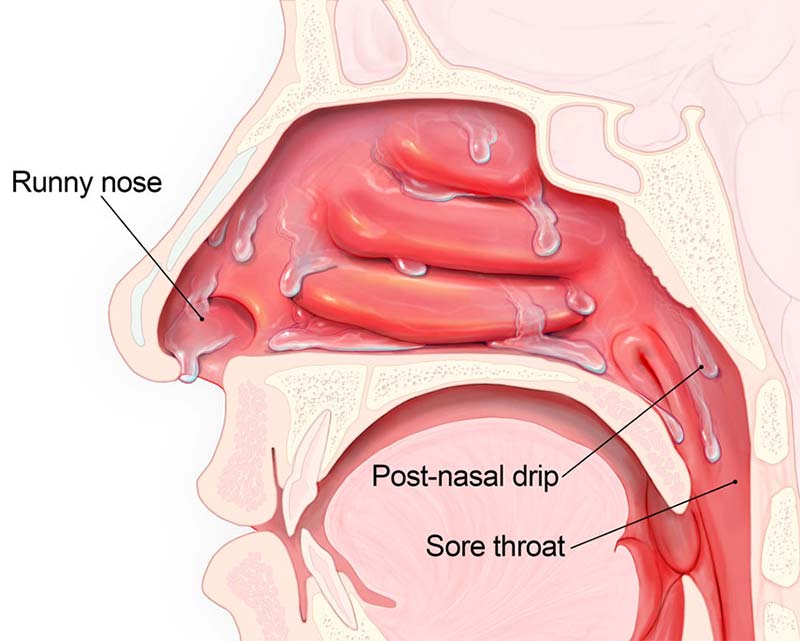
Nasal allergies often cause a persistent postnasal drip, “runny nose from the back”, which then leads to the dripping and buildup of mucus secretions in the throat and eventually landing on your child’s voicebox lower down to irritate it repeatedly. Then it’s no surprise that your child keeps coughing again and again because of this mucus backdrip landing on his vocal cords which react to shut together in the form of the cough reflex, to stop this mucky mucus from flowing down into your child’s windpipe to infect the lower airways of the lungs!
3. Enlarged tonsils and adenoids
Ultimately, if all the above symptoms keep persisting, then your poor child isn’t going to be able to sleep well because he can’t breathe well. Then you know it’s time to see your friendly ENT specialist in Singapore to get your child’s nose and throat thoroughly checked out for the above issues. Blocked nose, snoring and persistent cough are probably the most common ENT conditions I see in children in Singapore, in addition to ear infections and hearing loss in children!
Other conditions such as acid reflux or gastritis, may also cause a chronic cough and throat irritation, so sometimes, a paediatric gastro specialist may work hand in hand with your ENT surgeon to look after your child.
Share this blog via: